
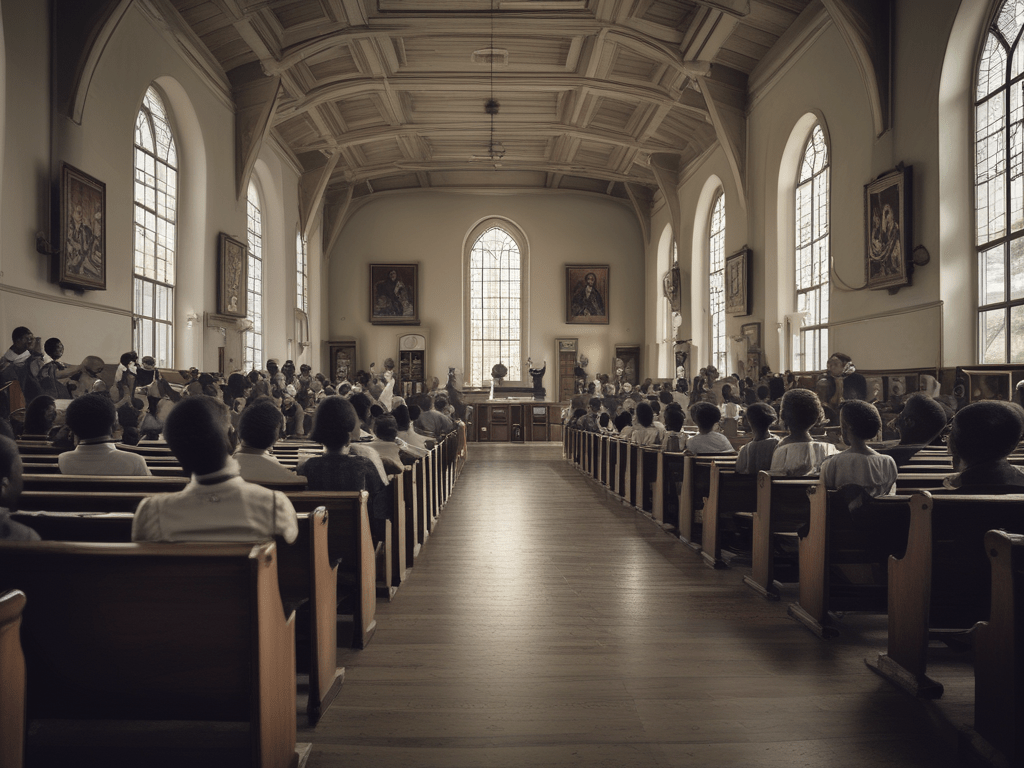
How were African Americans able to establish denominations in an unfree and segregated country? Many African Americans were brought to the New World as Slaves. This horrible institution led to African Americans having to practice religion separately from Whites. Eventually, separate churches and schools were formed by freed slaves which led to denominational initiatives. Historian Mark Noll explains “Blacks seized control of their own religious lives”.[1] African Americans were able to create new religious opportunities while dealing with racism and segregation. They were able to establish denominations in an unfree and segregated country by interpreting the scriptures in their terms, with the assistance of white preachers, and the growth of the Baptist and Methodist denominations.
The religion of African American Slaves flourished as a way of ordering and providing a vantage point from which to judge it.[2] But, when first introduced to Christianity, African Americans did not initially accept it. There were multiple reasons. Language barriers and cultural differences played a factor in preventing the acceptance of Christianity. In addition, to some settlers, Christianity contradicts the institution of slavery.[3] Some were trying to convince slaveowners to introduce Christianity and it would benefit them by making “slaves better workers than they otherwise would have been”.[4] Some followed suit but more were not convinced. These unconvinced individuals believed “Christianity among slaves came to be associated with revolt”.[5]
There were growing concerns about introducing Christianity to African American slaves. An example is in 1725 in South Carolina, a group of slaves revolted against their masters after reading a passage in the bible. The institution of slavery was evil and slaves seeking freedom in any matter should be commended, these were different times with different perspectives.
This uprising was not common, and whites began to teach scriptures to blacks. Knowledge and access to religious writing allowed individuals to pursue religious studies which helped convert slaves. Southern Baptists knew the importance of literacy, “the reading of his word we consider next in importance to the preaching of it”.[6] As blacks became more educated, they began to understand the scriptures and interpret the message. The Christian message being heard by blacks was different than what was being delivered. There were inaccuracies in the translation of Christianity. Many “white preachers to the slaves sought to sterilize the message”.[7] But, even with the efforts by whites to control all aspects of free blacks and slaves’ religion, they still created “their own folk religion and shaped it to their needs and interests”.[8]
There were educated blacks which countered the white preachers’ sermons. These inaccuracies provided hope to blacks because “the acceptance of religion did not only represent the simple promise of a blissful afterlife; it represented freedom from bondage and the beginning of a new way of life”.[9] The slaves’ communication allowed free play to the mind enabling African Americans to understand and comment “on the pathos, hu-mor, absurdity, sorrow, and warmth of the scenes they experienced”.[10] Slaves welcomed Christianity as a declaration of hope, self-respect, moral order and justice which eventually lead to black churches and denominations.
Due to whites feeling superior to African Americans, they were furthest outside to Christian groups. Yet “increasing numbers of African Americans adopted the Christian Faith”.[11] They were able to establish churches even with the resistance from white Americans.[12] Free blacks and slaves began to understand and even accept faith around the Revolution. They received lessons as historian, Will Gravely explained “because they had participated in the life of biracial congregations and denominations”.[13] Free blacks and slaves would accept their denominations as they were introduced to them.
During the Great Awakening, there were important preachers like George Whitefield and Samuel Davies who began to spread the gospel word. Their efforts to preach to African Americans steered the path which eventually led to blacks establishing their own churches and to a degree, denominations. George Whitefield is considered the “most important preacher of the Great Awakening”.[14] He preached to blacks during his missionaries’ ventures. While in Georgia, Whitefield received criticism for criticizing slaves’ owners. However, in time, he changed his stance and became an advocate for slavery in the state.
Samuel Davies “took an especially earnest interest in African Americans during his iterations in Virginia”.[15] Davies work with slaves was pivotal to the growth of Christianity among African Americans. He used hymns exclusively written for his effort among African Americans. In 1757, Davies wrote:
“what little success I have lately had, has been chiefly among the extremes of Gentlemen and Negroes. Indeed, God has been remarkably working among the latter. I have baptized about 150 adults; and at last sacramental solemnity, I had the pleasure of seeing the table graced with about 60 black faces.”[16]
The efforts of preachers like Whitefield and Davies during the Great Awakening had a major impact with the African American community. Christianity was growing among blacks and their faith became stronger due to the sermons they heard during the awakening which eventually led to black churches and black preachers. Historian, Dr. Charles H. Long explained when speaking of African Americans, “they overheard the Gospel, in describing the reception of Christianity among the enslaved Africans”.[17]
The first black church was “Silver Bluff Church in Aiken County, South Carolina”.[18] An African American preacher named David George established the congregation.[19] The establishment of this congregation had a significance impact. They were hearing sermons from an individual which they could relate too. It provided hope and a sense of prosperous days ahead.
These black congregations were rare during this time. Most black Christians were attached to a white congregation and denomination. Some African Americans were even appointed for service in white congregations. This should not go unnoticed. The importance of white missionaries spreading and allowing African Americans to attend white services was paramount to the growth of Christianity within the community. The first ordain African American minister in a major white denomination was Lemuel Haynes.[20] His reputation grew the next 30 years as he traveled throughout the Northeast spreading Calvinism. Although with his great success it could only reach certain heights, as some racial bias grew. He was forced to retire which showed to some blacks that they could only succeed to certain pinnacles within white denominations. Eventually, they need to separate in order to create their own path and freedom.
African Americans were introduced to religion from whites and their slaves owners. They were uncovering a faith that gave them spiritual purpose to their lives. There were multiple denominations that blacks come to responded through frontier preaching. These denominations also expressed disdain towards the institution of slavery. Baptist and Methodists paved a path for blacks which lead to their own churches and denominations.
Baptist and Methodist denominations were increasing its size due to slaves and free blacks joining its congregations. Baptists became controversial among slaves’ owners as many believed some Baptist’s supported slaves to revolt. They recruited from “the common people, and numbered women and African Americans among their leaders as well as followers”.[21] The Methodist denominations and some of their members believed in spreading their missionaries to all walks of life. Baptist and Methodist travelers got there earlier and to better affect. They arrived since the awakening with preachers and exhorters among the slaves themselves, so the “religion of the great antebellum revival did not come to them as an alien white intrusion”.[22]
Discussed earlier were important preachers which assisted in the growth of religion within the African Americans. There were members of Methodist denomination who impacted the African American community. Two members were John Wesley and Thomas Coke who sought to instill feeling and fortitude in the hearts. Wesley, known to be radically against slavery, wanted to spread the gospel. His methods led to Methodists going among the slaves and building a strong following. Coke preached the protestant “virtues of thrift, industry, and social peace”.[23]
Methodist allowed African Americans, regardless if freed or enslaved, to become licensed preachers. This included the South which was not common. Eventually led to black churches, first black Episcopal Church (1794), first black Methodist Church (1794), first black Northern Baptist Church (1809).[24] These congregations would remain with the National Level but in due time, after some disputes with land and other factors, there was a congregation that separated. This congregation would eventually become its own separate denomination. The Bethel Methodist Church would become the African Methodist Episcopal Church which was the one establishment under black control.[25]
African Methodist Episcopal Church (AME) started its own discipline in 1817. It led to another independent African American denomination joining the church. The Zion Church created in New York City follow suit. The history of these churches, which soon became its own denomination, is the most critical aspect to the growth of Christianity with the African American community.
To discuss the history of the African Methodist Episcopal (AME), one must introduce Richard Allen, born a slave who was converted by Methodists in his teen years. This church background “reveals much about the lengths to which African Americans Christians went to express the faith for themselves”.[26] Allen conversion began when Bishop Francis Asbury, leader of American Methodism, asked Allen to become his traveling companion.[27] Asbury saw the potential in Allen and ordained him several years later. By 1786, Allen preached to interracial groups of Methodists at St. George’s Church, Philadelphia and in Radnor Pennsylvania.[28]
Allen’s mission was to find and spread the gospel to his fellow African Americans. He was aided by others like Absalom Jones, William White and Dorus Ginnings. Their methods led to opposition by the St. George Church which eventually forced them from service and requested them to leave.[29] Another example where whites gave African Americans a venture to preach but would only allow certain parameters.
The discontent from St. George along with being asked to leave, these men through perseverance with aid from “Benjamin Rush and Robert Ralston raised funds for a new building, which became in 1794 the St. Thomas African Episcopal Church”.[30] Eventually, the friction between black and white Methodists led to Allen eagerness to form their own organization. Allen said to white Christians, “if you deny us your name as Methodists, you cannot seal up the scriptures from us, and deny us a name in heaven. We believe heaven is free for all who worship in spirit and truth.”[31] He sent out invitations to other black congregations and they all agreed to form African Methodist Episcopal (AME) church. The Pennsylvania Supreme Court ruled that the Bethel Church could control its own affairs and property.[32]
AME mission was to spread the belief “that human nature was perfectible, and that if social order which oppressed the black man were rearranged, he would become a productive citizen”.[33] They felt with the demise of slavery it allow all races to have a better society. The message was pure, and its goal was to destroyed slavery. They used spiritual singing to preach, similar to Davies hymns gave to slaves while in Virginia. Historian W.E.B Dubois explained “the most original and beautiful expression of human life and longing yet born on American soil.”[34] These songs are a testimony to a community creative genius, collective desire for freedom.[35]
The growth of AME was rapid, it started with 400 members and ventured into New York and New England area.[36] By 1836, the church membership grew to 7,594 and held conferences in the Midwest.[37] The denomination grew throughout the nation and spread gospel to blacks in order elevate the freedmen.
The growth of African Americans denominations was aided by the railroad system. After the Civil War, African Methodist Episcopalian assembled their resources and established a denominal church near a new railroad depot. The idea was more members of the denominations could move to the area due to the railroad being built in the town.[38] The idea to build churches around depot or terminal continued. It allowed blacks to attend services from far distances, regardless if the church was of a different denomination. The black churches opened their doors on Sundays to other congregations’ members which allowed for progress within the community. There was a developing relationship between railroad growth, black migration, and church formation.[39]
The AME did hesitate to grow in Southern States. They sent their own ministers and teachers to the South.[40] After the Civil War ended, some Christian delegates believed “the African Methodists are going to sweep the field”[41] The reason was the message Methodist were preaching. It was an uplift, discipline and educated message. They wanted to show that African Americans could succeed. They even called for more teachers to emphasize pride and independence. The AME church was “laying the groundwork for a post war explosion in membership”.[42]
The AME denomination led to other organized denominations within the African Community. After the Civil War, many freed African Americans left white controlled churches in order to establish their own. Even with the failures of the Reconstruction and Post Civil War, more African Americans “seized control of their own religious lives”.[43] There were important developments which included the growth of black churches in the South, growth of congregations within other denominations like Roman Catholics, Baptist and Pentecostal.[44] To understand prior to the Supreme Court ruling allowing Bethel church to runs its own entity, there were minimal congregations mostly in the North and 60 years later, there were multiple denominations and churches around the entire country.
African Americans were able to take the teaching from white ministers and alter to their own beliefs. “One might say that this history often expresses the merger of a kind of African American civil religion within the confines of Christianity”.[45] They were aided by some white preachers like Samuel Davies, George Whitefield and Francis Asbury. In the end it was African Americans understanding the gospel in their own terms regardless of how some slaves owners presented Christianity, the aid of important white preachers and most importantly the merger of several African American Churches creating the African Methodist Episcopal Church which led to their own denomination.
Bibliography
Bady, Eve J. From Bondage to Freedom: Slave Religion and the Slave Preacher. Order No. 1456936, Roosevelt University, 2008. In PROQUESTMS ProQuest Dissertations & Theses Global, http://ezproxy.liberty.edu/login?url=https://search-proquest-com.ezproxy.liberty.edu/docview/304805934?accountid=12085.
Baldwin, Lewis V. “Around the Family Altar: Domesticity in the African Methodist Episcopal Church, 1865-1900.” Church History 75 (3): 684–86, 2000.
Davis, David Brion. Inhuman Bondage: The Rise and Fall of Slavery in the New World. Oxford, England: Oxford University Press, 2006.
Genovese, Eugene D. Roll, Jordan, Roll: The World the Slaves Made [First edition]. New York: Pantheon Books, 1974.
Gerbner, Katharine Reid. “Christian Slavery: Protestant Missions and Slave Conversion in the Atlantic World, 1660–1760.” Order No. 3566885, Harvard University, 2013. In PROQUESTMS ProQuest Central; ProQuest Central; ProQuest Dissertations & Theses Global, http://ezproxy.liberty.edu/login?url=https://search-proquest-com.ezproxy.liberty.edu/docview/1417073271?accountid=12085.
Giggie, John Michael. After Redemption Jim Crow and the Transformation of African American Religion in the Delta. 1875-1915 New York: Oxford University Press, 2008.
Long, Charles H. “African American Religion in the United States of America: An Interpretative Essay.” Nova Religio: The Journal of Alternative and Emergent Religions 7, no. 1 (2003): 11-27. Accessed March 24, 2020. doi:10.1525/nr.2003.7.1.11.
Noll, Mark A. A History of Christianity in the United States and Canada 2nd Edition. Michigan: William B. Errdmans Publishing Company, 2019
Rable, George C. God’s Almost Chosen Peoples: A Religious History of the American Civil War. Chapel Hill: University of North Carolina Press, 2010.
Stowell, Daniel W. Rebuilding Zion the Religious Reconstruction of the South. 1863-1877 New York: Oxford University Press, 1998.
Walker, Clarence E. “The A.M.E. Church and Reconstruction.” Negro History Bulletin 48, no. 1 (1985): 10-13. http://ezproxy.liberty.edu/login?url=https://search-proquest-com.ezproxy.liberty.edu/docview/1296771711?accountid=12085.
Williams, Regennia N. “Of griots and grace: the art of oral history and the history of African American religion.” Black History Bulletin 68, no. 2 (2005): 15+. Gale In Context: World History (accessed March 28, 2020). https://link-gale-com.ezproxy.liberty.edu/apps/doc/A159180967/WHIC?u=vic_liberty&sid=WHIC&xid=79bdc065.
[1] Noll, Mark A, A History of Christianity in the United States and Canada 2nd Edition, (Michigan: William B. Errdmans Publishing Company, 2019), 312
[2] Genovese, Eugene D. Roll, Jordan, Roll: The World the Slaves Made [First edition]. (New York: Pantheon Books, 1974), 162
[3] Noll, A History of Christianity in the United States and Canada 2nd Edition, 67
[5] Ibid., 67
[6] Fountain, Daniel L. Slavery, Civil War, and Salvation: African American Slaves and Christianity, 1830-1870. (Conflicting Worlds. Baton Rouge: LSU Press, 2010), 53
[7] Genovese, Eugene D. Roll, Jordan, Roll: The World the Slaves Made [First edition], 166
[8] Davis, David Brion. Inhuman Bondage: The Rise and Fall of Slavery in the New World. (Oxford, England: Oxford University Press, 2006), 203
[9] Bady, Eve J. From Bondage to Freedom: Slave Religion and the Slave Preacher. Order No. 1456936, (Roosevelt University, 2008), 2
[10] Davis, David Brion. Inhuman Bondage: The Rise and Fall of Slavery in the New World, 203
[11] Noll, A History of Christianity in the United States and Canada 2nd Edition, 181
[12] Ibid., 181
[13] Noll, A History of Christianity in the United States and Canada 2nd Edition, 182
[15] Ibid., 97
[16] Ibid.
[17] Long, Charles H. “African American Religion in the United States of America: An Interpretative Essay.” Nova Religion: The Journal of Alternative and Emergent Religions 7, no. 1 (2003): 11-27. Accessed March 24, 2020, 18
[18] Noll, A History of Christianity in the United States and Canada 2nd Edition, 98
[19] Ibid.
[20] Ibid., 182
[21] Howe, Daniel W. What Hath God Wrought: The Transformation of America, 1815-1848. (New York: Oxford University Press, 2007), 181
[22] Howe, Daniel W. What Hath God Wrought: The Transformation of America, 1815-1848, 184
[23] Genovese, Eugene D. Roll, Jordan, Roll: The World the Slaves Made [First edition], 171
[24] Howe, Daniel W. What Hath God Wrought: The Transformation of America, 1815-1848, 182
[25] Ibid.
[26] Noll, A History of Christianity in the United States and Canada 2nd Edition, 183
[27] Mills, Frederick V. “Allen, Richard (1760-1831), American Methodist preacher and founder of the African Methodist Episcopal church.” American National Biography. 1 Feb. 2000; Accessed 15 Mar. 2020.
[28] Ibid.
[29] Ibid.
[30] Ibid.
[31] Noll, A History of Christianity in the United States and Canada 2nd Edition, 184
[32] Ibid.
[33] Walker, Clarence E. “The A.M.E. Church and Reconstruction.” (Negro History Bulletin 48, no. 1 1985), 10
[34] Williams, Regennia N. “Of griots and grace: the art of oral history and the history of African American religion.” Black History Bulletin 68, no. 2 (2005): 15+. Gale In Context: World History (accessed March 28, 2020).
[35] Ibid.
[36] Walker, Clarence E. “The A.M.E. Church and Reconstruction.” (Negro History Bulletin 48, no. 1 1985), 10
[37] Ibid.
[38] Giggie, John Michael. After Redemption Jim Crow and the Transformation of African American Religion in the Delta. 1875-1915 (New York: Oxford University Press, 2008), 35
[39] Giggie, John Michael. After Redemption Jim Crow and the Transformation of African American Religion in the Delta, 1875-1915 (New York: Oxford University Press, 2008), 36
[40] Rable, George C. God’s Almost Chosen Peoples: A Religious History of the American Civil War. (Chapel Hill: University of North Carolina Press, 2010), 294
[41] Ibid.
[42] Ibid.
[43] Noll, A History of Christianity in the United States and Canada 2nd Edition, 312
[44] Ibid., 313
[45] Long, Charles H. “African American Religion in the United States of America: An Interpretative Essay.” Nova Religion: The Journal of Alternative and Emergent Religions 7, no. 1 (2003): 11-27. Accessed March 24, 2020, 18

 Mostly History
I hope everything goes well .I’m subscribing. Have a happy day ☘️🍀
LikeLike