
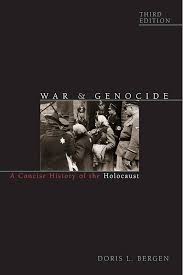
Bergen, Doris L. War & Genocide: A Concise History of the Holocaust, 3rd Ed. (Lanham, MD: Rowman & Littlefield Publishing Group, 2016, Pp. v, 361).
Reviewed by Albert Morales.
There have been many different books written about the Holocaust. Some examples are written memoirs by survivors or historians researching and writing secondhand accounts. This should not come as a shock to anyone since this event had global ramifications. But this book provides some different context. Doris Bergen, a Holocaust historian, Chancellor Rose, and Ray Wolfe Professor of Holocaust Studies at the University of Toronto, wrote War & Genocide: A Concise History of the Holocaust. She researched the Holocaust and attempted to prove her thesis.
Her book makes 4 major claims about the event: the Holocaust was a global event with worldwide repercussions; the Holocaust happened “step by step; the event “needs to be understood in the context of that conflict”; and Jews were the primary targets of this destruction, but their destinies related to other victim groups (Bergen 2016, 1). Bergen connects her four major claims by reiterating, “the Holocaust was an event in human history” (Bergen 2016, 1). She emphasized that human emotions were involved in all aspects. This includes perpetrators, witnesses, and victims. They all played a role in the Holocaust.
The initial chapter, “Dry Timber: Preconditions”, focuses on why, and deepens the question with another, “what made the holocaust possible” (Bergen 2016, 13)? The chapter provides the starting point and prerequisites for the rise of Nazism. The Holocaust was not a singular event. It’s a multifaceted process that grows over multiple years. Bergen breaks down the question into multiple parts. The first is a sub question, “why the Jews” (Bergen 2016, 14)? She answers the questions with the history of antisemitism and its various forms.
There was a diverse group of Jewish people spread throughout Europe. In some cases, they lived alongside Christians and Muslims. There were different social and wealthy classes of Jewish people. Bergen credits Nazi propaganda for creating the “category of the Jew, a composite based on myths and stereotypes” (Bergen, 2016, 20). She explains that there was no race identified as Jews. Now, Jews did differentiate among themselves like other religious sectors. but, the Nazis did not generalize or separate the distinctions amongst Jews. Their violence targeted all Jews. Bergen provides an example from a memoir by Peter Gray. Gray discusses his father and does not recall ever being ridiculed or harassed. They considered themselves German and did not find as Jewish solely.
Most historians focus solely on the Jews’ antisemitism, but Bergen provides context about Romas, disabled people, Afro-Germans and other groups that were targeted during the Holocaust. She adds that the Nazis were not the first to target these groups. This section answers one of her 4 claims that Jews were the primary target but related to other groups. She felt it was important “thinking about non-Jewish and Jewish victims together reveals something important about Nazi persecution” (Bergen, 2016, 25). Additionally, violence became infectious to the Nazis, hence the reasons why other groups slid under most Jews. Bergen continues with several sections explaining the attitudes towards the disabled, Roma, Sinti, homosexuals, and other targeted groups. She wraps up the chapter by blaming the Great War. Admittedly, the Great War was not the only factor, but it “prove that human life was cheap and expendable” (Bergen, 2016, 43). Bergen felt the war left behind a legacy of violence that helped paved the rise of Nazism.
The second chapter, “Leadership and Will” focuses on Adolf Hitler’s leadership and the Nazi Party. Bergen wants to answer how an ordinary person became the leader of a destructive enterprise. First, she explains the differences between certain types of scholars. There are scholars that disagree with how crucial Hitler was. She describes the differences between internationalists and functionalists. Internationalists consider Hitler to be the mastermind behind the mass murder and give the fact that it was a calculated plan. On the other hand, Functionalists believe the Holocaust was “a function of other developments, especially during the war” (Bergen, 2016, 46). They believe Hitler’s role was not crucial and was more of a pawn. Bergen admits she took the internationalist stance because she wants to find out the cause of Nazi crimes. To this question, Bergen believes, “we need to study those who initiated and carried them out” (Bergen, 2016, 46).
The book continues with the third and fourth chapters. These chapters focus on the Nazi Party prior to the start of the Second World War. Bergen believes the first six years between 1933-1938 were crucial to their rise and growth. Trying to answer the question, “how did Hitler begin to implement his ideas of race and space during the peacetime years of Nazi rule (Bergen, 2016, 69)? She provides context about the Nazi Revolution and the routinization. Initially, Hitler’s political position was not strong. But Hitler targeted Communism. He believed he gain allies by attacking this party within Germany. He used propaganda to gain support and blame communists for the uptick in violence throughout Germany. Bergen gives great details of the rise of his power and popularity among some Germans.
Bergen started the book by explaining the Holocaust was a human event. The concluding chapter examines if there is a happy or sad ending. Bergen is conflictive with this question. The Holocaust was a tragic event that had a devastating effect. The Allied victory did not immediately stop the destruction. Many troops were shocked to see some of the killing centers. Bergen admits there is no redemption story that “leaves us only with human beings, with their startling capacities for good and evil, and with an awareness of the complex ties that connect the fates of people and nations all over the world” (Bergen, 2016, 310). She adds that the Holocaust has a vicious legacy that still has a lasting effect.
Doris Bergen’s book is an excellent piece of writing. She achieved a level of analysis that is both complex and understandable. This reading covered a wide range of matters that are relevant to the Holocaust. Readers will learn multiple aspects that include Adolf Hitler, the rise of the Nazi Party, the reason they turned to destructive methods, and why they targeted certain groups. Bergen’s thesis is provided, and she answers the questions very well.

 Mostly History