
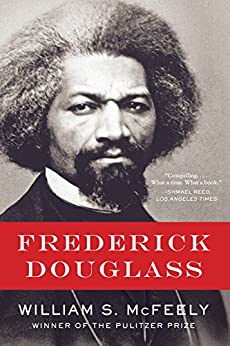
McFeely, William S. Frederick Douglass. New York: W&W Norton Company, 1991.
The Frederick Douglass story is beyond remarkable. A runaway slave turned abolitionist, during a time African Americans struggled for freedom and equal rights. During his life, Douglass wrote multiple autobiographies. His work was written beautifully with much detail. To this day, many historians appreciate Douglass’s most powerful narrative and his most spectacular success is his life story. William McFeely book titled, Frederick Douglass, reiterated this appreciation. McFeely’s book captures Douglass’s unique story and effectiveness as a proponent of freedom and equality for African Americans.
Douglass has told his story since he left Covey’s Farm. From his first published work, Narrative of the Life of Frederick Douglass, An American Slave, his goal was to give hope to slaves and free blacks throughout the nation. He wanted to provide the horrific details about the institution of slavery. McFeely thesis mirrors Douglass’s goals. “It brings his story forward to the time of its writing, but the slavery days are still there, as if to remind an American eager to forget that slavery cannot be purged from the national memory” (McFeely 1991, 6).
McFeely starts with Douglass’s early upbringing on the Talbot County. He explains Douglass’s struggle with his mother. Douglass had no memory of his mother during his days at Betsy’s Cabin. He only recalled the few times his mother visited Aaron Anthony’s fields. Douglass himself suggests, “I cannot say I was very deeply attached to my mother” (McFeely 1991, 5). The first few pages of the book are devoted to this broken relationship. It was powerful to read that a son has no recollection of his mother due to slavery. McFeely has many of these similar instances throughout his book. Douglass had special relationships with women throughout his life.
Douglass relationship with women started with his grandmother, “the central presence in this life during his childhood”.[1] McFeely takes note of this relationship, “Douglass’s stress on the impressive competence of his grandmother” (McFeely 1991, 7). Another important relationship was with his master sister-in-law, whom he called Miss Sophia. She treated him with kindness and taught him the alphabet. “I was treated as a child” (McFeely, 1991, 26). These relationships with women were important to Douglass. McFeely’s biography does a good job bringing these relationships to life.
The biography dwells into several other aspects. Another important one is Douglass days in Ireland. Douglass left America shortly after publishing his first autobiography. An interesting letter was written to William Lloyd Garrison while in Limerock. Many Irish were suffering in Ireland, these poor Irishmen heard Douglass’s speech about inequality in America but couldn’t get pass their own suffering. Douglass writes to Garrison, “I see much here to remind me of my former condition and I confess I should be ashamed to life my voice against American slavery, but that I know the cause of humanity is one the world over” (McFeely 1991, 137). He felt that the chain was linked to all people who suffered. This chapter was powerful with its revelation that a once enslaved man could have pity for free whites.
McFeely’s biography is well written and built around the life of Frederick Douglass. But some historians have criticized McFeely’s writing methods. Richard McMurry wrote a review in The Mississippi Quarterly and explained “the tone of the book is burdened with the current politically correct academic fad”.[2] McMurry also does not appreciate the lack of cited work found in the biography. The book does contain a lot of quotes but there are notes with the cited work for each quote towards the end of the biography. Some of McMurry’s criticism could be considered a reach since the biography has notes and biography. It’s not uncommon to find positives and negative reviews so it’s important to discuss both.
Waldo Martin’s tone is different than McMurry, “McFeely does a marvelous job of deconstructing the self-constructed Douglass and sensitively explores the interconnections between the public and private man”.[3] Martin reviewed explains McFeely details on how Douglass maintains his relationships with prominent women throughout his life. “Douglass relationships with black and white women throughout his life demonstrates a man more at ease with women than men.”[4] Martin review is more in line with other historians.
Frederick Douglass life will always be researched and written on. His story is too remarkable and accomplish to not enlighten others. Many Historians point to his rise to prominence as evidence of his importance in written history. McFeely’s biography does not fall short of this notion. It provides details into his early life in Talbot County to Cedar Hill. His days as a Pre-Civil War abolitionist to being appointed as the Commissioner of Haiti. McFeely does not fail in his biography on one of the most important abolitionists in American History.
[1] James McPherson, “The Agitator – Frederick Douglass by William S. McFeely”, (The New Republic, Mar 11, 1991), 38
[2] Richard McMurry, The Mississippi Quarterly 44 (no. 4 1991), 511
[3] Waldo Martin. The American Historical Review 98, (no. 2 1993), 565
[4] Ibid.
References
Gerteis, Louis S. “Book Reviews – Frederick Douglass by William S. McFeely.” The Journal of American History 78, no. 4 (03, 1992): 1448
Martin, Waldo E. The American Historical Review 98, no. 2 (1993): 565-66.
McMurry, Richard M. The Mississippi Quarterly 44, no. 4 (1991): 509-12.
McPherson, James M. “The Agitator – Frederick Douglass by William S. McFeely.” The New Republic, Mar 11, 1991. 37-41

 Mostly History