
The year is 1887, over 20 years since General Robert E. Lee surrendered in Virginia. Freed African Americans slaves are trying to acclimate to their freedom. Black settlements are forming throughout the United States. So, in a small area located in Central Florida, African Americans established a town called Eatonville. This small town is considered the first Incorporated African American municipality in America. It was an achievement for once-enslaved black men and women throughout nation.
The historic township of Eatonville is “childhood home to Harlem Renaissance author Zora Neale Hurston and a heritage tourism site marketed today as the Oldest Incorporated African American Municipality in America”.[1] The town is named after Josiah Eaton. Eaton was joined by fellow union officer Captain Lewis Lawrence and Joseph Clark with establishing the town. They wanted to “create a village for the colored people in the near vicinity of his grove”.[2] Eaton purchased many acres and built a church to proclaim the achievement (see Fig. 1).
Eatonville was a town to “promote home ownership and self-governance among African-Americans workers”.[3] As Zora Neale Hurston explains, Eatonville was a town built to “thrive with a sense of pride and security that was denied to many black people in the South”.[4] The establishment of the town quickly help other areas. Due to African American owning property, it played a pivotal role in the 1887 incorporation of Winter Park. African Americans voters “provided crucial votes for incorporation and, for a brief time, held elected town offices alongside whites”.[5] However, as Historian Scot French explain it was this display of unity within the black community that possibilities led to “first state-chartered” all black town. Although some scholars argue Princeton, NC also claimed to be the first Southern all-black towns in American history. This notion is disputed by Eatonville officials.
After the Civil War, many freed slaves moved to different parts of the country. Many towns “offered freedom from white dominance and the chance for blacks to govern themselves”.[6] For this reason, many towns like Princeville claim the notion that they’re the first all-black town. However, Eatonville representatives explains their town was founded “entirely by blacks, was the first incorporated all-black town because Princeville had about 45 white residents until 1900, when it became nearly all black”.[7]
Establishing the municipal of Eatonville was no easy task. To establish a success town, the residents and officials need funds and materials to build said town. In addition, food and the proper equipment is needed. However, due to racial prejudice these resources were not readily available. Imagine moving into a new neighborhood and residents did not welcome you. Or you needed assistance to move a large piece of furniture upstairs and no one offered a helping hand. These examples were a reality for African Americans in Eatonville.
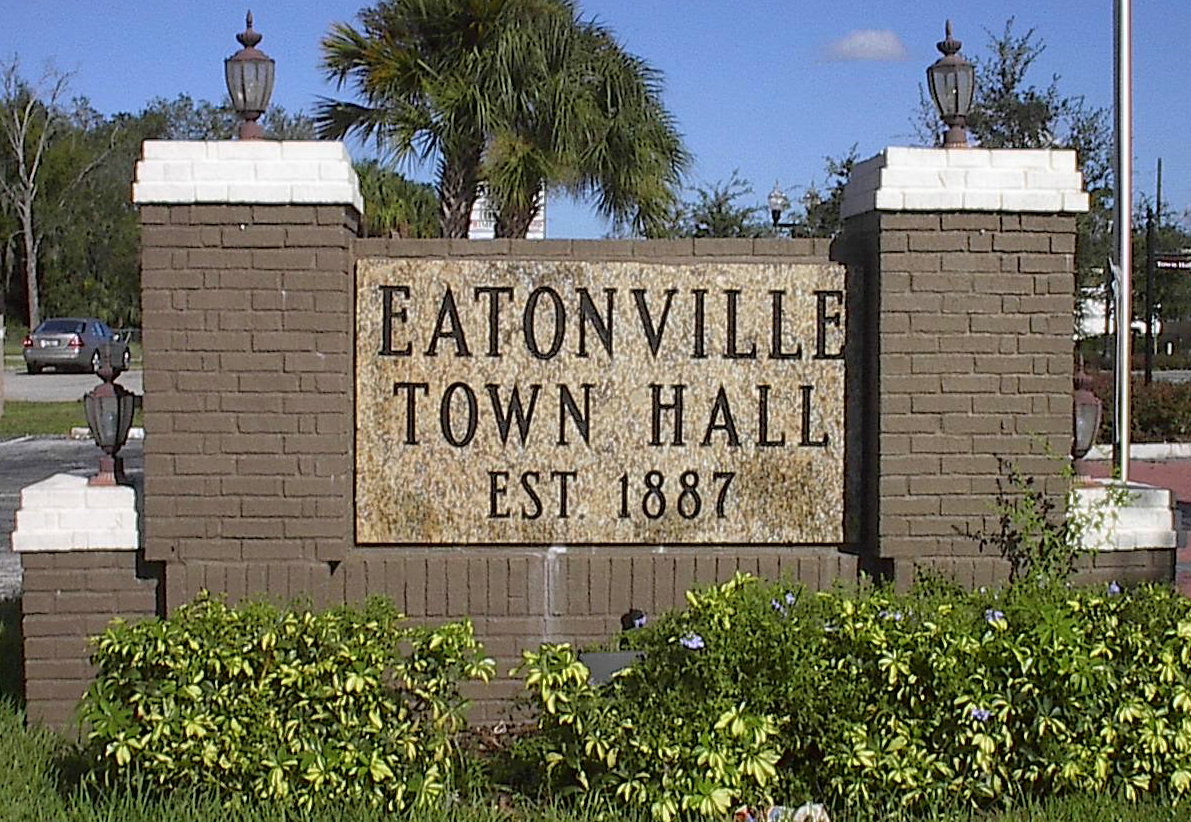
Fig. 1 – Eatonville, FL[8]

Biography:
Beauchamp, Gorman. “Zora Neale Hurston’s Other Eatonville.” (The Texas Review 32, no. 3–4 2011), 75–87.
French, Scot. “Social Preservation and Moral Capitalism in the Historic Black Township of Eatonville, Florida: A Case Study of “Reverse Gentrification”.” (Change Over Time 8, no. 1 2018), 54-72.
Johnson, Constance. “A Place to Be Free.” U.S. News & World Report., vol. 112, no. 8, US News Pub Corp., 1992.
Manigault-Bryant, James A., and Lerhonda S. Manigault-Bryant. “Conjuring Pasts and Ethnographic Presents in Zora Neale Hurston’s Modernity.” (Journal of Africana Religions 4, no. 2 2016), 225-235.
[1] Scot French, “Social Preservation and Moral Capitalism in the Historic Black Township of Eatonville, Florida: A Case Study of “Reverse Gentrification”, (Change Over Time 8, no. 1 2018), 56
[2] Ibid., 60
[3] Ibid., 62
[4] Gorman Beauchamp, “Zora Neale Hurston’s Other Eatonville.” (The Texas Review 32, no. 3–4 2011), 76.
[5] Scot French, “Social Preservation and Moral Capitalism in the Historic Black Township of Eatonville, Florida: A Case Study of “Reverse Gentrification”, 64
[6] Constance Johnston, “A Place to Be Free”, (U.S. News & World Report., vol. 112, no. 8, US News Pub Corp., 1992)
[7] Ibid.
[8] Scot French, “Social Preservation and Moral Capitalism in the Historic Black Township of Eatonville, Florida: A Case Study of “Reverse Gentrification”, 61

 Mostly History